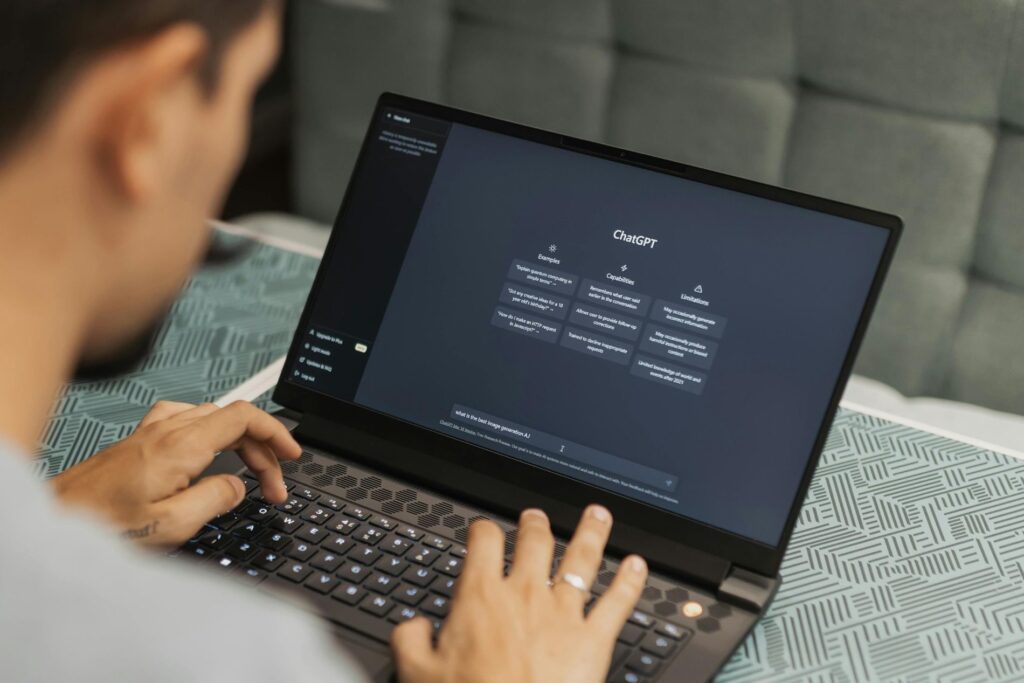

Every week, it seems like a new tool promises to “revolutionise your business” with artificial intelligence. But for many companies, these promises fall flat when, instead of smoother operations, they get extra complexity, higher costs, and a rapidly growing list of tools no one fully understands.
At Crosstek, we decided to take a different route. We asked one simple question:
How can we use AI to make life better for our clients and easier for our team, without compromising on security or adding unnecessary layers of complexity?
The result isn’t flashy. It doesn’t involve chatbots that write your emails or dashboards with flashing lights. But it does save almost five minutes per helpdesk ticket. And over the course of hundreds of tickets each month, that really adds up.
Here’s how we did it, and why it might be worth thinking about AI a little differently
The problem with AI for AI’s sake
A lot of AI projects seem to start because someone said, “We should be doing something with AI.”
That’s fine in theory. But in practice, it often leads to businesses introducing tools that cost a lot with very little measurable impact, introduce increased security risk by exposing sensitive internal data to third party systems, require extra training or tech knowledge to use properly, and don’t actually solve a real problem.
AI that’s barely noticeable
We embedded AI directly into our helpdesk workflow, not as a shiny new platform, but as a quiet, helpful assistant that works in the background. The core idea is that when a support ticket comes in, the AI reviews the contents and helps prep it for the engineer automatically. A triage system, if you like.
It’s not replacing the engineer’s job, it’s making it more efficient, allowing them to get through more tickets without additional admin. The result? Every ticket saves around five minutes of admin and triage time. That might not sound like much, but 30 tickets in a day saves an hour and a half, over a week that’s 7.5 hours, over a month that’s 30 hours, and over a year that’s 360 hours of engineer time that can now be spent actually fixing things!
A simple example
Imagine a staff member sends in a support request that says, “Printer’s jammed again. Can someone help?”
Traditionally, an engineer would have to follow up to find out:
- What kind of printer is it?
- Where is it located?
- Is it a hardware issue or a software glitch?
- Has this happened before?
Now, with our AI-enhanced triage system, here’s what happens instead:
- The AI identifies the issue as printer-related and categorises it (e.g. “Printer > Paper Jam”),
- It gives the engineer a 2–3 word summary of the issue,
- It checks for context, like whether the request is from a VIP like the CEO and therefore if the work is pre-authorised or if they need to seek permission.
The AI can even be trained to pick up patterns over time, helping us spot recurring issues and address the root cause, not just the symptom.
That said, we’re not leaving it to machines!
AI is good, but it’s not perfect. That’s why it’s important to design a system that always keeps a human in the loop. Think of it like a writer using spellcheck. It helps, but it’s no replacement for good judgment from a proofreader.
Our engineers review and approve all AI-generated suggestions. It speeds things up while still allowing for expert oversight, and that’s the key component to maintaining quality while making the process more efficient.
AI is also prone to something called ‘hallucinations’. This is when it doesn’t know the answer, so it will simply make things up. To triage our tickets, the AI assistant has been trained to pick its answers from some pre-approved lists, in a bid to stop it going rogue and making up what the ticket is about.
Security is non-negotiable
One of the biggest concerns around AI is data security, and rightly so.
Many off-the-shelf AI tools send your data to external servers. That might be fine if you’re asking it to write a product description. But it’s a non-starter when you’re dealing with sensitive customer data, IT systems, or business operations.
That’s why we run our AI processes inside our own secure environment. That means no sensitive data is shared with third-party platforms, compliance standards are maintained by us, and client information stays protected.
What businesses can learn from this
We believe the best use of AI isn’t necessarily the most exciting one, it’s the one that makes a real difference in how your business runs. For us, that means faster support ticket resolution, less repetitive admin for our engineers, and ultimately leading to a better service for our clients, which is something we’re always striving for, with or without AI.
The real takeaway is this, though: AI works best when it’s solving a real problem and doing it quietly in the background. Training it to do that takes work!
Whatever industry you’re in, AI doesn’t have to be overwhelming or expensive. Used well, it can be the ultimate time-saver. A win all-round!
Are you looking for forward-thinking, efficient IT support? Get in touch with us today, that’s what we’re here for!
You may also like: Microsoft uses AI agents to combat hacking